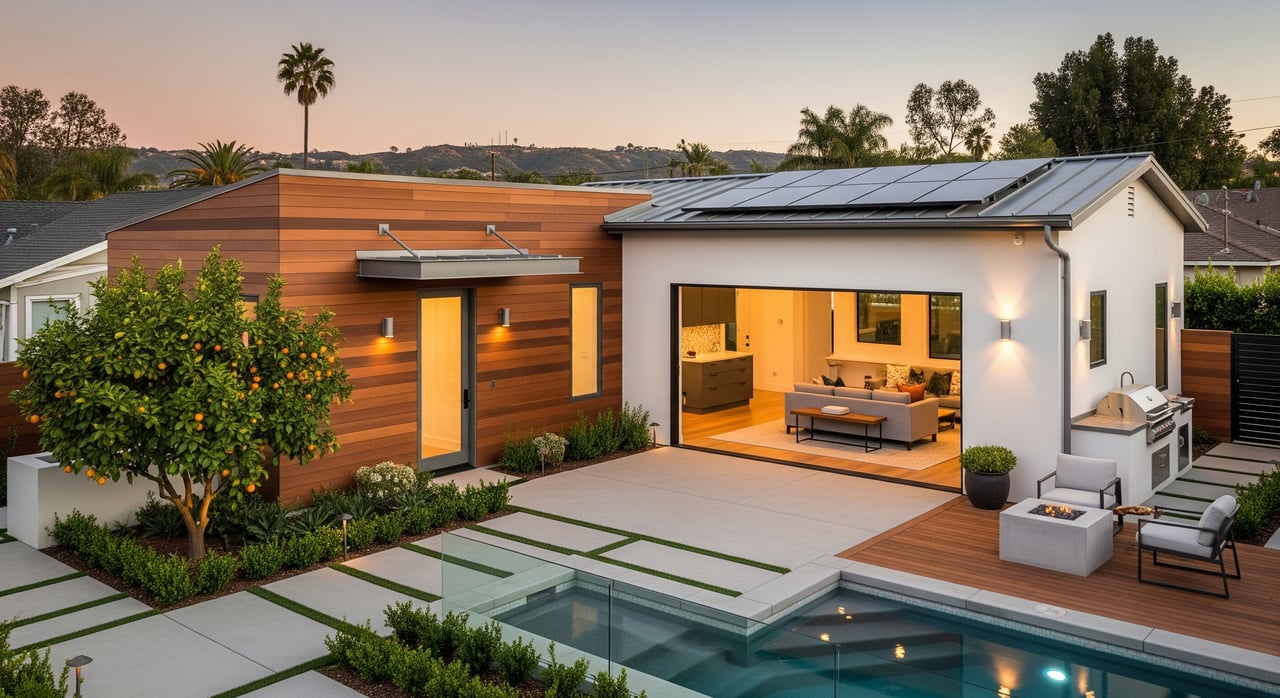
Thinking about adding an ADU to your Orange County property to offset your mortgage or create long-term wealth? You’re not alone. With high home prices and solid rental demand, ADUs are a practical way to create flexibility and income. In this guide, you’ll learn how the rules work, what projects cost, what ADUs typically rent for, and a simple way to model cash flow in Anaheim–Santa Ana–Irvine and the City of Orange. Let’s dive in.
California ADU rules that set the stage
California state law makes ADUs easier by requiring ministerial approval when you meet objective standards. That means the city must use a clear checklist rather than a subjective design review. You submit a complete application and, if it meets the rules, the city issues the permit.
State law also pushes cities to review complete applications promptly. Timelines vary by city, but the process is designed to move in weeks to a few months, not many months of discretionary hearings.
You can build ADUs (attached or detached) and Junior ADUs (JADUs) created within an existing or proposed single-family home. Size caps and footprints exist at the state level, and cities can apply objective standards within those limits. Check the latest state guidance and your city’s ADU page for exact caps.
Owner-occupancy restrictions are limited by state law for most ADUs. JADUs have historically had different rules. You can generally rent an ADU short or long term unless local ordinances, coastal rules, or HOA covenants restrict it.
Parking rules are flexible. Cities cannot require more than one space for an ADU in most cases and must waive parking in certain situations, such as near transit. Setbacks and lot coverage still apply, but state law relaxes some barriers to make projects more feasible.
Cities may charge impact or development fees, yet these must be proportional to the ADU’s size and impact. Some smaller ADUs or JADUs have fee limits or exemptions. Local governments can apply objective design standards like roof pitch or materials, but not anything that effectively blocks ADUs or requires discretionary approval.
How Orange County cities implement ADUs
Every jurisdiction in Orange County follows state law but with its own checklists, standards, fees, and workflows. Expect ministerial permitting if you meet objective rules, then plan for differences in documents, plan check timing, utility requirements, and fees.
- Anaheim: Expect a ministerial path if you meet objective standards. Parking, fees, and submittal requirements are outlined in city materials.
- Santa Ana: The city provides ADU resources and follows objective code requirements. Confirm permit fees and any short-term rental rules.
- Irvine: The planning division implements ADU rules and may have design standards for planned developments. Some neighborhoods have HOA covenants that apply.
- City of Orange: The city publishes an ADU information sheet and checklist. Confirm any park-impact fees, utility connections, and historic neighborhood design standards.
- Unincorporated Orange County: Development Services processes ADUs. Rural parcels may need septic or well review.
- Coastal zones (parts of Newport Beach, Huntington Beach, Costa Mesa): Local Coastal Programs can add steps and extend review time if the Coastal Commission is involved.
Typical permitting steps
- Feasibility and pre-application check to confirm setbacks, lot coverage, and utilities, plus any HOA restrictions.
- Complete application with site plan, floor plans, elevations, parking plan, energy compliance, structural details, sewer or septic verification, and fees.
- Plan check for building, structural, mechanical, electrical, and plumbing.
- Inspections during construction and a final occupancy inspection.
Common approval delays
- Incomplete submittals or missing engineering/energy calculations.
- HOA covenants or CC&Rs that restrict accessory structures or rentals.
- Septic capacity reviews or well approvals on rural lots.
- Coastal Commission involvement in coastal zones.
- Utility upgrades such as sewer laterals or water meter capacity.
What it costs to build in Orange County
Use these ranges as a planning baseline. Actual bids vary with scope, finishes, and site conditions.
- Garage conversion: about $40,000 to $120,000.
- Interior conversion (JADU or small ADU): about $50,000 to $150,000.
- Detached small ADU (300–700 sq ft): about $150,000 to $350,000.
- Detached larger ADU (700–1,200+ sq ft): about $250,000 to $500,000+.
Key cost drivers
- Scope and square footage: conversion vs new construction, ceiling heights, layout.
- Site work: grading, foundation, retaining walls, utility tie-ins, soils/engineering.
- Finishes: basic rental finishes vs high-end packages.
- Labor and materials: local market conditions and price volatility.
- Access: narrow lots, limited staging areas, or shared drives can add time and cost.
Typical timeline
- Permit review for a complete application: about 30 to 90 days depending on city workload.
- Construction duration:
- Garage conversion: about 2 to 8 weeks.
- Small detached ADU (300–700 sq ft): about 3 to 6 months.
- Larger detached ADU: about 5 to 9+ months.
- Total project from feasibility to occupancy: roughly 4 to 12 months. Coastal or complex sites may take longer.
What ADUs rent for in Orange County
Rents depend on city, finishes, privacy, parking, and location. As general guidance:
- Studio or small 1BR ADU: often about $1,700 to $3,000+ per month.
- 1BR ADU: often about $2,000 to $3,000 per month.
- 2BR ADU: often about $2,500 to $4,000+ per month.
Irvine typically lands on the higher end. Anaheim and Santa Ana tend to be more moderate. Coastal cities often command higher rents. For pricing, pull recent comps for your immediate neighborhood and match by size, bed/bath count, finishes, private entry, parking, and in-unit laundry.
How to set rent for your ADU
- Gather 3 to 6 recent rental comps from platforms like Zillow Rentals, Apartments.com, RentCafe, Zumper, and Craigslist.
- Adjust for square footage, condition, privacy, and amenities.
- Check if utilities are included and whether parking is dedicated.
- Validate demand by tracking days on market and recent rent reductions in your area.
A simple cash-flow model you can use
You can screen an ADU project with a straightforward framework. Start with these inputs:
- Build cost: Cbuild.
- Permit, impact, and utility fees: Cfees.
- Financing: loan amount, rate, term, and fees.
- Monthly rent: R.
- Vacancy: v (for example, 5 to 8 percent).
- Operating expenses: Op (insurance, owner-paid utilities, maintenance, management).
- Property tax impact from added assessed value.
- Initial equity: E0 (cash invested).
Then calculate the basics:
- Gross annual rent = 12 × R.
- Effective gross income = Gross annual rent × (1 − v).
- Operating expenses = Op (as a dollar amount or percent of rent).
- Net operating income (NOI) = Effective income − Operating expenses.
- Annual debt service = annual mortgage payment.
- Annual pre-tax cash flow = NOI − Debt service.
Key return metrics:
- Cash-on-cash return = Annual pre-tax cash flow ÷ E0.
- Cap rate (for investment analysis) = NOI ÷ total project cost.
- Payback period = E0 ÷ Annual pre-tax cash flow.
Example scenario (for illustration)
- Detached small ADU build cost: $250,000.
- Fees and soft costs: $15,000.
- Total project cost: $265,000.
- Financing: 80 percent at 6 percent interest, 30-year amortization.
- Rent: $2,400 per month.
- Vacancy: 6 percent.
- Operating expenses: 30 percent of effective gross income.
Results:
- Gross annual rent: $28,800.
- Effective income after vacancy: $27,072.
- Operating expenses (30 percent): $8,121.60.
- NOI: $18,950.40.
- Approximate annual debt service: $12,000.
- Estimated annual cash flow: about $6,950.
- Initial equity (20 percent of total cost): $53,000.
- Cash-on-cash return: about 13.1 percent.
What moves returns the most
- Achieved rent per month.
- Cost overruns versus your budget.
- Vacancy and management approach.
- Financing terms and lender structure.
- One-time local requirements such as sewer laterals, water meter upgrades, or fire sprinklers.
Property-level underwriting checklist
Use this to evaluate a specific Orange County property before you commit.
Feasibility quick check
- Confirm zoning allows an ADU and note single-family or multifamily rules.
- Measure lot dimensions and setbacks against your city’s objective standards.
- Identify utilities: sewer vs septic, water meter size, electrical capacity.
- Check for HOA or CC&R limits on accessory structures or rentals.
- Flag overlays: historic districts, slope, easements, trees, or coastal zone.
Documents to gather
- Address, parcel number, lot size, year built, and existing square footage.
- City zoning and ADU standards pulled from the city’s checklist.
- Recent property tax bill and assessed value.
- Site photos and a simple sketch of the proposed ADU location.
Cost inputs
- One to three contractor bids or a preliminary per-square-foot estimate.
- City permit, impact, and utility connection fees.
- Soft costs: architectural, engineering, Title 24 energy, plan check contingency.
- Financing assumptions: interest rate, loan-to-cost or loan-to-value, fees.
Income and expense inputs
- Market rent comps from your immediate neighborhood.
- Vacancy: 5 to 8 percent default unless comps suggest otherwise.
- Operating expenses: insurance, owner-paid utilities, maintenance, and management.
- Property tax change from added assessed value.
Run scenarios in your model
- Base case with conservative rent and realistic costs.
- Upside case with stronger rent or lower costs.
- Downside case with cost overrun, softer rent, and longer vacancy.
- Review NOI, cash-on-cash, payback, and sensitivity to rent and cost changes.
Permitting and closing considerations
- Budget contingency of 10 to 20 percent based on scope and site complexity.
- Timeline contingency for plan check cycles and inspections.
- Confirm lender requirements for construction and permanent financing.
Ready to explore ADUs with Mint?
If you want a second set of eyes on feasibility, rents, and cash flow, we can help you apply this framework to your exact property and scenario. Our team pairs on-the-ground Orange County expertise with investment-grade analysis so you can move forward with clarity and confidence. If you are buying, we can also source properties where an ADU makes financial sense. Connect with Mint Real Estate to start your ADU plan.
FAQs
What are the key California rules for ADUs in Orange County?
- State law requires ministerial approval for ADUs that meet objective standards, limits parking and owner-occupancy requirements, allows cities to charge proportional fees, and permits objective design rules that do not block ADUs.
How long does it take to permit and build an ADU in OC?
- Plan on about 30 to 90 days for review of a complete application, then 2 to 9+ months for build-out depending on scope. Total time from feasibility to occupancy often runs 4 to 12 months.
How much does a garage conversion ADU cost in Orange County?
- A typical garage conversion runs about $40,000 to $120,000 depending on code upgrades, utilities, and finishes.
What rent can I expect for a 1BR ADU in Irvine or nearby cities?
- A 1BR ADU often rents about $2,000 to $3,000 per month, with Irvine commonly on the higher end and Anaheim or Santa Ana more moderate. Verify with recent neighborhood comps.
Do I need to provide parking for an ADU on my lot?
- Cities cannot require more than one parking space for most ADUs and must waive parking in certain cases, such as near transit, subject to state rules and local objective standards.
Can I rent my ADU short term in Orange County?
- State law allows ADU rentals, but local short-term rental ordinances, coastal rules, or HOA covenants may restrict stays under a certain number of days. Check your city and HOA before you list.