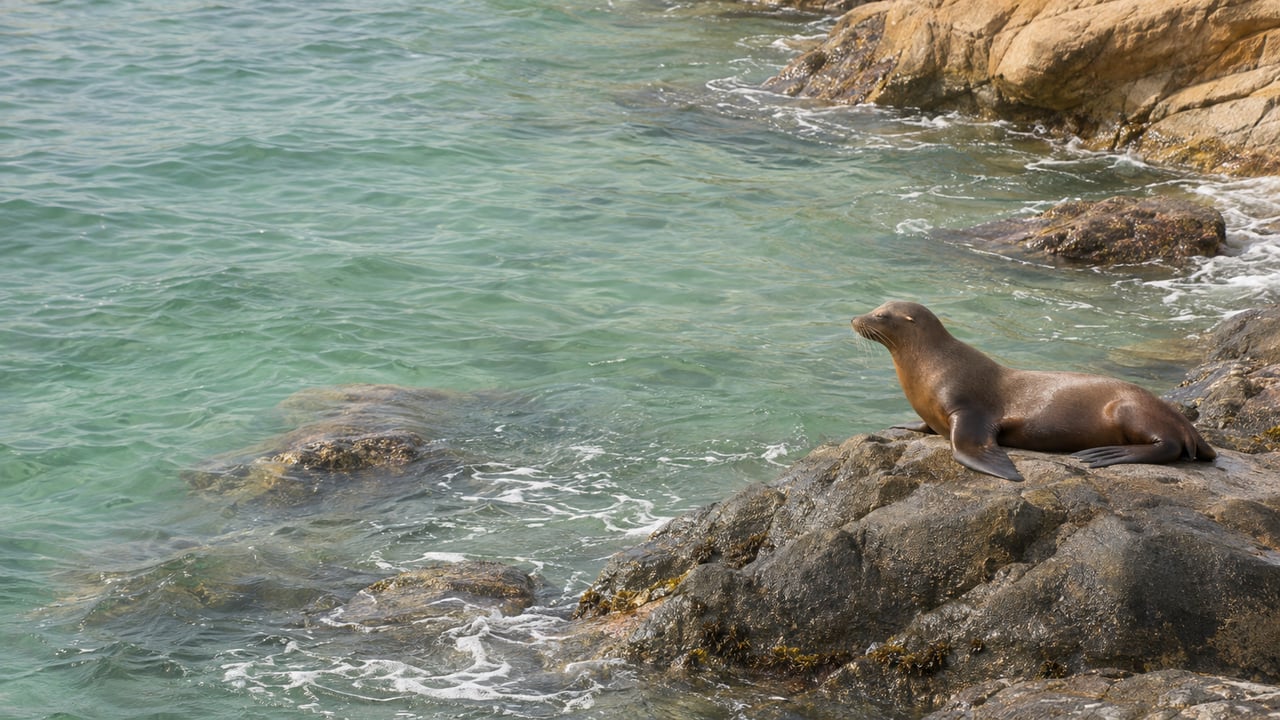
The red barn on Laguna Canyon Road opened its gates to the public on Monday, October 12, 2026. Visitors had been kept out since October 2023, and the reopening followed a three-year, $20 million expansion. The new rehabilitation pools had no seals or sea lions in them. In its reopening announcement, Pacific Marine Mammal Center said it had no animals in-house "due to seasonality of rescues."
That timing explains the center's year. The campus reopened in its quietest stretch, and its busy season starts now. The pools, the viewing windows and the water system went in for the months between November and April, when pups come in. This winter is the first time the public can watch patients in the new pools.
The reopening came in the slowest weeks
The Daily Pilot reported on October 16 that the center had no patients on site as of that week. It had responded to 146 stranded marine mammals so far in 2026: 102 sea lions, 16 fur seals, nine cetaceans, eight elephant seals, seven sea turtles and four harbor seals. The year before was much busier. Center officials told the paper that a toxic algae bloom had the center caring for more than 500 animals in 2025.
People came anyway. Associate veterinarian Kelsey Reames told the Daily Pilot that many members of the public had come in with no animals on site, "so interested to see what we've done, see the facility, see it open up." She said she looked forward to "having all the guests come in and see the animals when we eventually get them."
The first patient arrived 12 days after the reopening. The center's patient page listed one animal in-house as of early November. Leonard is a female yearling northern elephant seal, rescued October 24 at M Street in Newport.
| Date | What happened at the center |
|---|---|
| October 2023 | Closed to visitors; animal care moves to a temporary field hospital |
| October 6, 2026 | NOAA officials inspect and certify the expanded facility |
| October 12, 2026 | Public reopening, with no patients in-house |
| Week of October 12 | Still no patients on site, per the Daily Pilot |
| October 24, 2026 | Leonard, a yearling elephant seal, rescued in Newport |
| Early November 2026 | One patient listed in-house |
November through April is pup season
On its visitor page, the center says it typically sees more pups from November to April. Late winter and early spring are its busiest months, because pups are weaning from their mothers and are prone to malnourishment and dehydration. Ocean conditions can change any given year. The center lists domoic acid and El Niño or La Niña among the factors.
Patients stay an average of two to four months. That means a pup admitted in December could still be in a pool in March. Animals are released once their weight, health and foraging ability meet the center's criteria and they pass a pre-release exam under anesthesia. After that, the release has to happen within 14 days. Release day starts early in the morning at a local beach, and the center releases at least two seals or sea lions together whenever it can. The two most recent releases on the patient page before the reopening were Rozanov on August 21, 2026, and Rokette on September 16, 2026.
The new pools were built so the public can watch
The center had seven small pools. It now has 10. Three of the additions are worth finding on a visit.
- The pre-release pool. This 5,000-gallon pool was funded by The Sue J. Gross Foundation in honor of Nicholas W. Gross. Staff use it to watch whether a patient can forage before it goes back to the ocean, and it has an underwater viewing window.
- The treatment suite window. The new patient treatment suite has a window into the room where hospital work is done.
- The 10,000-gallon rehabilitation pool. Marilyn Green funded this pool. It lets the center treat larger animals such as dolphins.
The underwater window is set low on purpose. Reames explained the reasoning to the Daily Pilot:
"It works because the eye line of the sea lion is lower than the eye line of people, so we can look down on them. If we were eye to eye, we wouldn't want that, so we're not habituating them. It's not a zoo."
The same care shows up in the center's rules for staff. Patients are wild animals, so staff avoid eye contact, don't talk to them or call them by name, and never hand-feed them. Every window on the campus works within those rules. On a weekday in February, the window is how a visitor sees a yearling sea lion learning to catch fish without the sea lion seeing the visitor.
The yard shows pinnipeds: California sea lions, northern elephant seals, Pacific harbor seals and northern fur seals. The center says visitors will not see whales, dolphins or porpoises there.
The water system behind those pools
The building visitors walk past first is the one that makes the busy season easier to run. The center used to clean and refill its pools three times a day. That made it the second-highest water user in Laguna Beach, behind only city government. The new Jeff & Carla Meberg Water Reclamation Center cost $5 million and covers 2,000 square feet. It is designed to reclaim nearly 5 million gallons a year, about 90% of the center's water use.
Water quality specialist Kelly Hawkins told the Daily Pilot why that matters for the animals. "In the past, we had to keep dumping and filling, dumping and filling," she said. Now the system is "essentially a closed-loop system, where the water we're introducing is fresher and cleaner," with UV sterilization that helps with eye problems and open wounds. Pool temperatures stay within a four-degree range all year, and staff can set one pool apart for a particular animal. Leonard came in with an eye injury, and that is the kind of care the system was built for.
The rest of the campus is also ready for winter crowds.
- Massen Greene Education Center: A new 1,600-square-foot classroom, funded by the Massen Greene Foundation, doubles the center's capacity for onsite programs. Laura Frost, the center's distance learning and after-school programs coordinator, painted its mural of underwater marine mammal scenes.
- MacGillivray Media Center & Studio: Laguna Beach residents Greg and Barbara MacGillivray funded this studio. It broadcasts distance learning programs and "Healing Seals," a program for children's hospitals around the country.
- Art around the yard: Casey Parlette's bronze sculpture "In Pursuit" places a sea lion among fish and kelp. Mike Tauber built the "Friends of the Sea Lion" wall from tiles painted by donors. Chris Barela painted a dolphin and elephant seal pool mural with Laguna College of Art and Design alumni Emma Crespo and Jordan Tacker.
How a visit works
- Where: 20612 Laguna Canyon Road, next to the Laguna Beach Animal Shelter and the dog park, about six minutes from downtown. Look for the red barn.
- When: The Bob Barker Visitor Yard is open every day from 10 a.m. to 4 p.m. It closes on Thanksgiving, Christmas Eve, Christmas Day and New Year's Day, and for weather closures announced on social media.
- Cost: General admission is free, and the center encourages donations.
- Reservations: You don't need one, but the center strongly encourages them so its team can prepare for visitors.
- Parking: The onsite gravel lot is free but small. When it fills, there is metered parking along Laguna Canyon Road.
- Pets: Not allowed, except trained service animals.
- Groups: A 20-minute guided yard tour costs $7 per person for groups of 10 to 30. A 60-minute program costs $12 per person for groups of 8 to 35.
Before you go, check the patient page to see who is in care. The yard can look very different from one week to the next.
When the call comes from your own beach
Pup season also starts on the sand. The center's rescue hotline for stranded marine mammals is 949-494-3050. The response team asks callers for the animal's location and a photo or video.
The center was founded in 1971 by two Laguna Beach lifeguards, John Cunningham and Jim Stauffer. Michele Hunter, director of animal care, has been there 37 years, longer than any other employee. At the October 4 gala she received the first PMMC Founders Award for an estimated 7,000 patients cared for over her career.
Neighbors who want more than a visit have two ways in. Volunteer roles include animal care, education docent, visitor-yard greeter, outreach and the Tower 71 Gift Shop. Most roles require volunteers to be 18 or older, and there are junior positions for ages 15 to 17. Memberships last 12 months and run from $50 for Seal Supporter to $6,500 for Benefactor's Circle. Higher tiers include invitations to public releases, the early-morning beach send-offs that mark the end of each patient's stay.
Here at Mint Real Estate, we're glad to see the red barn open again and running on a full winter schedule. If you'd like an Orange County agent who keeps up with the canyon as closely as the coast, we're happy to talk. Save the rescue hotline in your phone, 949-494-3050, before your next beach walk.