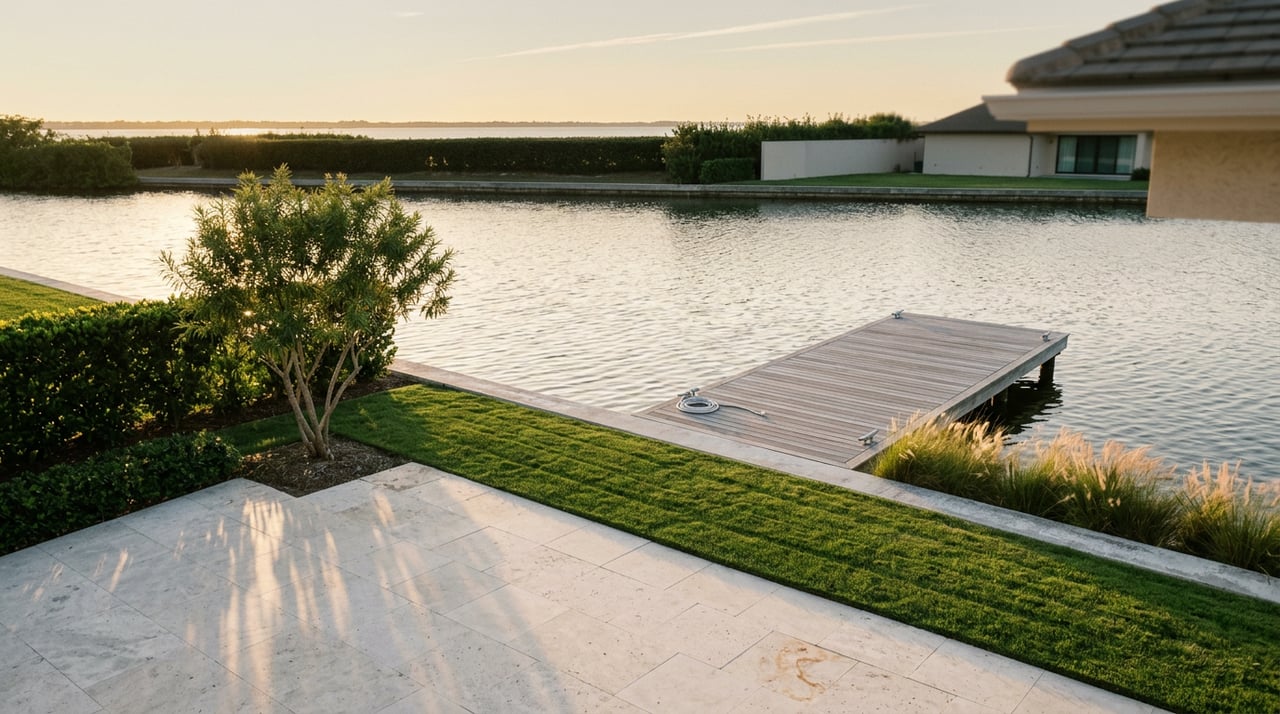
Two listings, same week, same asking price, both on Newport Harbor. One sits behind a private gate in Bayshores, dock included, marina access included, no city inspection pending. The other sits on a standalone lot along the open harbor, dock included too, but the permit that lets that dock exist is issued by the City of Newport Beach, sits over public tidelands, and is currently caught in the middle of a state-ordered rate review that could change what it costs to keep.
Same price. Same square footage. Completely different asset behind the seawall.
Most guides to buying waterfront in Newport stop at the first fact: you don't own the water, you own a permit to put a dock on it. That's true for the majority of the harbor, and it's worth knowing. But it treats "waterfront" as one product when it's actually at least three, and the difference between them determines how much homework a buyer needs to do, how much negotiating room exists, and whether the thing you're buying is exposed to a fee increase that regulators have already flagged as overdue.
Three Very Different Docks Behind Three Very Different Bulkheads
On most of Newport Harbor's open bayfront, a private pier sits on a permit issued by the City of Newport Beach's Public Works Department, good for up to ten years, attached to the owner of the adjoining land rather than to the dock as a standalone asset. The city administers more than 850 of these residential pier permits along the bayfront, and every one of them sits on tideland the state holds in trust and the city manages on its behalf. When the home sells, the permit doesn't just follow the deed. Buyer and seller both have to sign a transfer application, pay a fee, and let the city inspect the dock, with a turnaround the city itself puts at five to fifteen working days, longer if the dock fails inspection and needs repairs before a re-inspection is scheduled. That's the version most buyers hear about, and it's the version currently in regulatory crosshairs.
Balboa Island runs on a different system entirely, and it shows up in a detail most buyers never think to ask about: paint color. The island's perimeter piers are marked blue for public or white for private, and only the white ones belong to a specific homeowner. New noncommercial piers on Balboa Island generally aren't approved unless the Harbor Commission finds a specific public interest in adding one, which in practice means the supply of private docks around the island is close to fixed. If a listing on Balboa Island comes with a white pier, that permit isn't just a convenience. It's something the next owner effectively can't recreate by petitioning the city for a new one.
Then there's Bayshores, the guard-gated enclave off Coast Highway near Dover Drive with roughly 250 homes, two private beaches, and its own marina. The community's common areas, including its docks, are privately held by the Bayshores Community Association rather than run through the city's residential pier permit system, and the marina itself is owned by The Irvine Company and operated separately by California Recreation Company. Of those roughly 250 homes, only a small fraction sit directly on the water, and fewer still come with a private dock. A Bayshores buyer isn't dealing with a city transfer application at all. They're dealing with an HOA and a marina operator, which is a different kind of homework, but it also means the property isn't subject to the tideland rent review reshaping the rest of the harbor.
Why the Gap Between Two Lines Matters More Than Square Footage
For properties on the standard city permit system, the number that actually drives value isn't lot size. It's the distance between two surveyed lines: the bulkhead, which marks where private land stops and public tideland begins, and the pierhead line, which marks how far out into the water a dock or float is allowed to extend. Both lines in Lower Newport Bay were set by an act of Congress, and only Congress can move them. A parcel with a wide gap between its bulkhead and pierhead line can accommodate a genuinely large vessel. A parcel a few doors down with a narrow gap can't, no matter how large the house behind it is. Two homes built to identical specs can carry very different water rights, and that difference doesn't show up in a square footage comparison. It shows up when someone tries to dock a 60-foot boat behind a dock rated for 40.
The Rent That Isn't Fixed
Here's the part of the story that's moving right now, and it only applies to the standard city permit system, not to Bayshores or to Balboa Island's public piers.
In December 2025, the California State Lands Commission reviewed how Newport Beach manages its harbor tidelands and concluded the city has not been charging fair market rent on residential piers. The commission's own staff report noted that while mooring permit rates have followed a regular cycle of independent appraisals, residential pier rents have instead trended down over the years through reductions in billed area and rate cuts, without comparable reappraisals, a pattern the report characterized as more political than market-driven. The commission directed the city to commission new independent appraisals, reconsider how pier rental area is even calculated, including whether the interior space of U-shaped piers should count, and review whether piers being subleased are being billed at the lower residential rate when they should be paying commercial rates.
The city's own published timeline runs through new appraisals during 2026, a series of Harbor Commission public meetings on fees and transferability running into the following winter, and a comprehensive policy package headed to the City Council for a vote in 2027. The city held its first public meeting on the harbor's future in late May 2026 and has said no rate increases or transfer changes take effect without council approval and public notice. Nothing is finalized as of this writing. But the direction of travel is clear enough that a seller's current pier rent, often a modest annual line item, shouldn't be read as a fixed number going forward. It's a number under active review by the same regulator that just told the city it's too low.
This is happening alongside a related fight over offshore mooring permits, where the state has recommended ending the long-standing practice of privately selling mooring transfer rights. That's a separate asset class from a residential pier, but it's part of the same broader tidelands review, and it signals a city being pushed toward more consistent, appraisal-driven pricing across every category of harbor use.
Before You Write the Offer
For a standalone city pier permit, a few checks are worth doing before the number on the listing sheet becomes the number in your offer.
- Ask the seller for their current annual pier rent in writing, and treat it as a figure likely to move rather than a fixed carrying cost.
- Confirm the permit is active and currently in the seller's name, not a family member's or a prior owner's.
- Get the bulkhead and pierhead line locations for the specific parcel, not a neighboring one, since the gap between them sets the real ceiling on vessel size.
- Order an independent dock and bulkhead inspection separate from the city's transfer inspection, since the city's review is a safety pass rather than a full structural assessment.
- If the pier is subleased to someone else, ask directly whether it's being billed at the residential or commercial rate, since that's one of the specific practices under state review right now.
For Balboa Island, the question changes. It's less about rent and more about confirming a white pier is actually permitted to that property, since new private piers are difficult to add. For Bayshores, the due diligence runs through the HOA and the marina operator rather than the city, and it's worth asking directly which of the roughly 250 homes carry deeded dock access versus shared marina privileges.
A Couple of Things Worth Asking Directly
Can I add a new private dock on Balboa Island if my listing doesn't already have one? Generally, no. The Harbor Commission only approves new noncommercial piers there when it finds a specific public interest in doing so, which makes an existing white pier considerably more valuable than the prospect of adding one later.
Will my pier rent change before I close escrow? The city has said no rate changes take effect without City Council approval and public notice, and that vote isn't expected until 2027. Today's rent is safe through closing. What isn't safe is assuming it stays where it is afterward.
Newport Harbor rewards buyers who ask what kind of waterfront they're actually looking at, not just whether the listing says "dock included." The permit system, the paint on the pier, and the name on the HOA all change what you're buying and what it will cost to keep. Mint Real Estate works Newport Beach's bayfront streets often enough to know which system a given address falls under before an offer goes in. If you're weighing a harbor property, find my dream home and let's look at what's actually behind the seawall.